
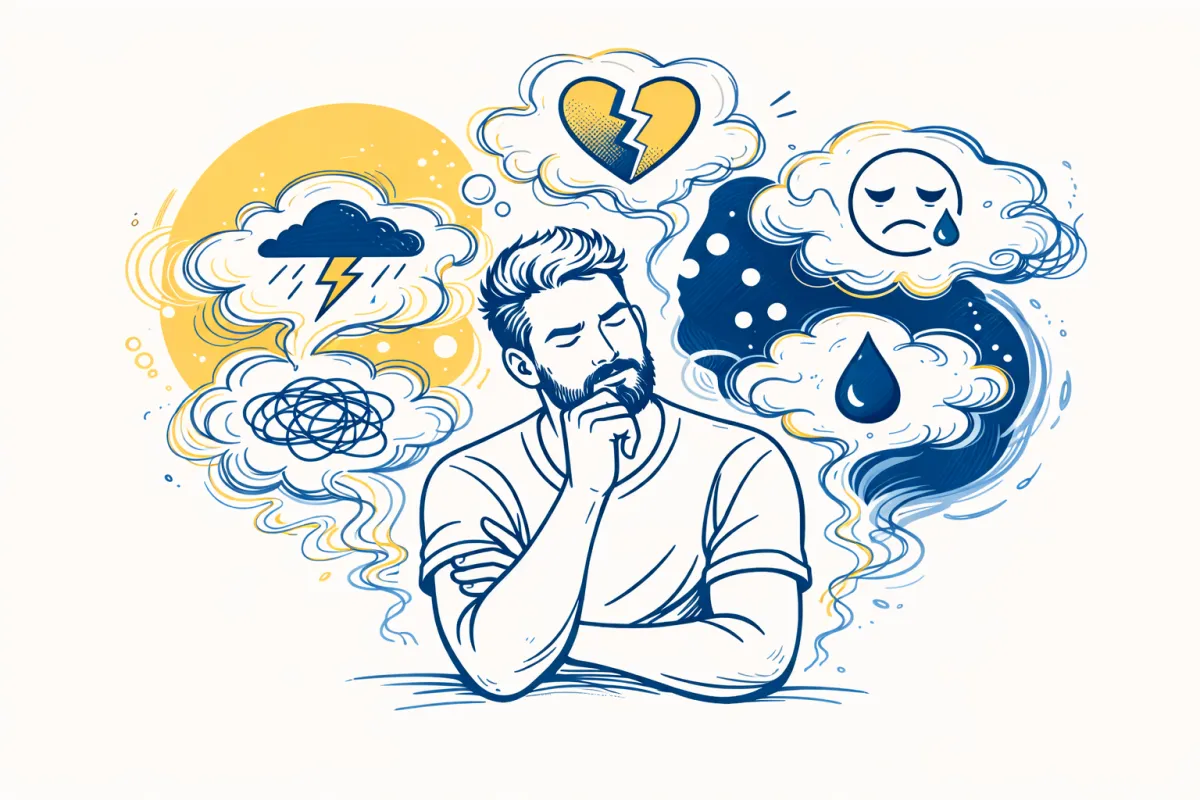
Emotions are Data
Emotions Are Data, Not a Problem to Get Rid Of
A while back, I heard Connor Beaton reference a poignant Carl Jung idea that has been ruminating within me, casting a spotlight revealing the dusty corners of my heart.
Jung's thought reveals a consequential truth that subconsciously governs many of our lives, like a sneaky shadow playing nefarious tricks with our emotions.
Most people quote it like this: "Until you make the unconscious conscious, it will direct your life and you will call it fate."
Whether Jung said it in that exact wording gets debated. What Jung did write is this:
“The psychological rule says that when an inner situation is not made conscious, it happens outside, as fate.”
One of my favorite spiritual authors and lecturers, Anthony De Mello, says it this way:
“What you are aware of you are in control of; what you are not aware of is in control of you.”
The problem both Jung and De Mello are calling out is the parts of ourselves we're unaware of that we've given control over. These shadows, these thoughts, these assumptions, these beliefs, are quite literally controlling us. We become slaves, as De Mello writes, to all that we are unaware of.
But freedom and renewed perspective are not mystical problems to solve or debate. Awareness is the simple first step. It's the key that unlocks our ability to move in the direction our hearts truly want to go. It is simple, and it's practical.
I'll speak for myself. There are times in my life when I desperately wanted to be someone different. I've hated myself at times. I've cursed myself for making the same mistake not twice, but an untold number of times. "Why do I keep doing this? Why do I keep saying that?" Why do I keep being this way?"
I have lived parts of my life being led around by certain emotions like a dog on a leash. I've struggled and scraped with depression and loneliness, resentment and anger in truly unhealthy ways. It saddens me, and I flush with embarrassment when I look back at some of those seasons.
And I also understand that this is part of learning and growing, part of the human experience, so I can look back through the lens of grace and know that I am not unique. I am not alone. Unnamed emotions have sabotaged nearly everyone at some point.
What "fate" looks like in real life (at least in my shoes)
To be clear, I am not an expert on managing emotions. I am learning and growing right alongside you.
With that in mind, here are some examples from my own life where I've been tempted to call situations and experiences I've endured "fate" when they were natural occurrences or consequences of not connecting with and calling out emotions.
I've repeated the same fight in different relationships.
I've gotten reactive at work, then later told myself, "That's just how I am."
I've shut down, disappeared, numbed out, doom scrolled, overworked, used substances, and tried to stay busy enough to avoid the quiet.
Then I've called the results "bad luck," "timing," or "life," when a lot of it is simply an unexamined negative pattern. My dad would call it "Murphy's Law." That kind of negative thinking catapulted me into even darker times internally: deeper depression, more volatile anger, more walls haphazardly constructed around my heart.
A better frame: emotions are data
What I know for sure is that I am not alone. Many of us, especially men, were taught to treat emotions like a liability. Something to control, hide, or muscle through. As in, "Stop crying. Big boys don't cry!" or "Shame on you!" or "Man up."
I could go on with the myriad statements boys and young men have heard from their fathers and elders over the years. Instead of teaching us how to handle, understand, and work with emotions, we were taught to stuff them down into the forgotten corners of our hearts.
Back to Conor Beaton's perspective. He calls emotions data points. In other words, emotions are informative bits of data that are trying to tell us something important. They are signals that something is triggered, something deeper than just the fleeting feeling that I'm experiencing in this moment.
It might not always be pleasant or clean information. Or the information could be a sign of something beautiful I need to maximise in my life. Either way, the information is useful and worth our time to investigate.
A useful analogy Conor spoke of is that if you were going to make a serious business decision, you would want good data. You would look at the numbers. You would study trends. You would check reality.
Emotions can work the same way. They tell us what matters. They show us where pressure is building. They reveal needs we keep stepping over.
They are not a command. They are a signal.
The two traps men fall into
1) Ignore the data
Stuff it down. Move on. Stay productive. Stay "fine."
2) Get hijacked by the data
As in...Anger takes the wheel. Anxiety runs the day. Shame shuts everything down.
Most men I know do not want to live or lead a life controlled by subconscious forces. Most of us want to be true leaders, if not only in our personal lives, for those around us. These two traps undermine our intentions.
Awareness is the turning point
I hesitate to fold in this infamous quote from Viktor Frankl, but it fits so well in this context:
“Between stimulus and response there is a space. In that space is our power to choose our response. In our response lies our growth and our freedom.”
Taking time to pause in that space of awareness is the crux. It is nearly impossible to pause once my emotions have hijacked me, or certainly if I shove down and ignore the data.
Again, awareness is the key to unlocking our ability to connect with and understand our emotions.
Simple Steps
My encouragement to myself is to be patient and gracious with myself as I grow in awareness. Conor Beaton's guidance is relevant to that end. Here is what he encourages us to do:
When emotions are brimming, we can ask ourselves three simple questions:
1) What am I feeling right now, honestly?
One word is enough. Angry. Anxious. Embarrassed. Overwhelmed. Lonely. Disappointed.
2) What is this feeling trying to tell me?
What matters here? What value feels threatened? What need is not being met?
3) What is the next right move?
Simply the next right move. Not the reactive, dramatic move.
Maybe it is a boundary you need to establish, an apology, resting, having those hard conversations, or asking for help.
A question to sit with
Where in your life have you been calling something "fate" that might actually be an unspoken pattern?
This is an invitation to get super curious about your inner life, to let go of shame, and